How to Order Water Delivery in Nairobi: 5 Options Compared (2026 Guide)
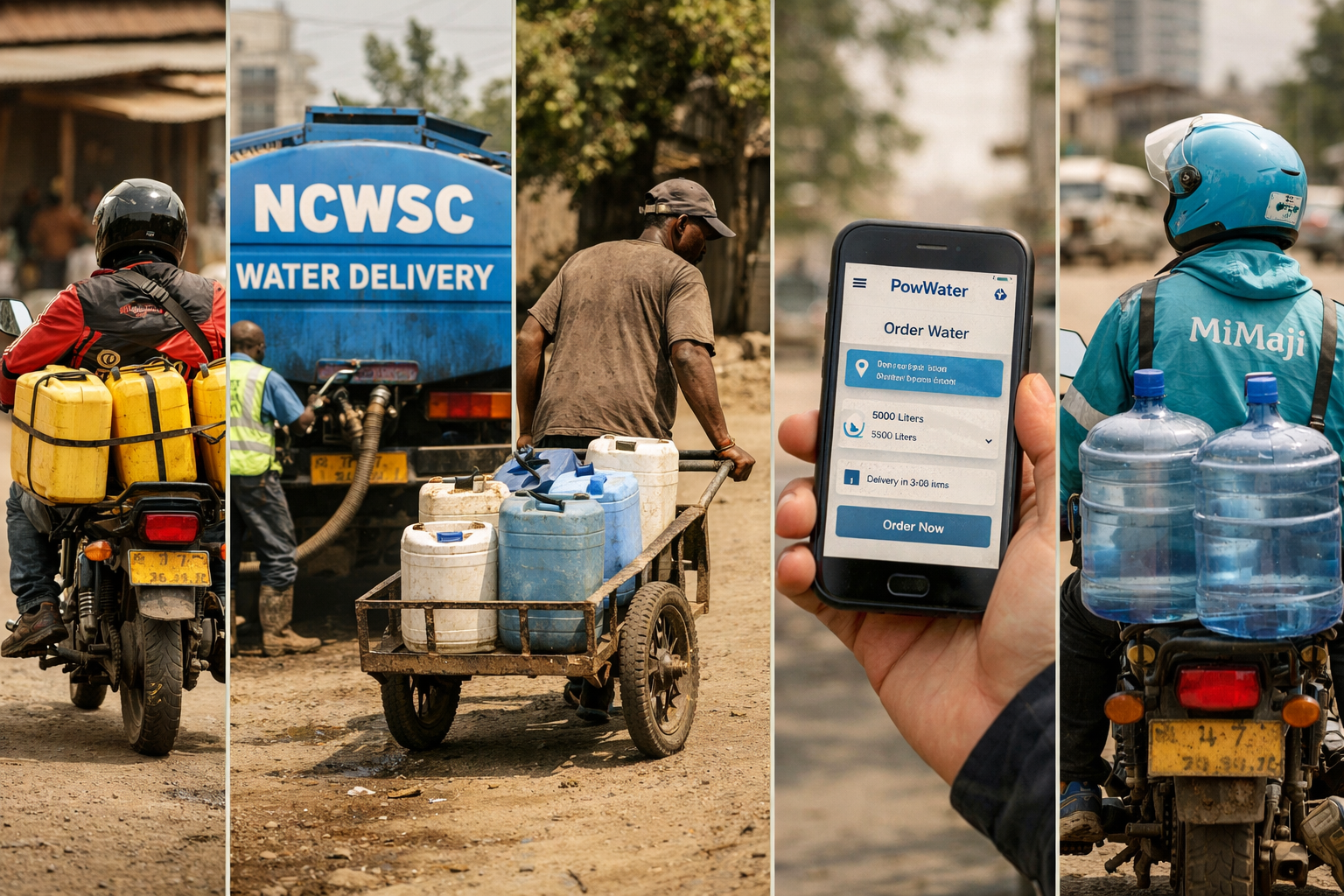
Your taps are dry. Again. You need water for your family, and you need it today. But what is the best way to get water delivered to your door in Nairobi in 2026? The options range from the traditional (calling your neighbourhood boda boda guy) to the modern (ordering through a mobile app). Each has its own trade-offs in terms of price, quality, speed, and reliability.
This guide compares all five major water delivery options available to Nairobi residents, with honest assessments of each so you can choose what works best for your situation.
Option 1: The Boda Boda / Informal Vendor
How It Works
You call or WhatsApp a boda boda rider you know (or one recommended by your caretaker/neighbour). You tell them how many jerrycans you need. They go to the nearest water kiosk, borehole, or water point, fill up, and ride to your home. You pay cash on delivery.
Pricing
KSh 30 to KSh 100 per 20-litre jerrycan, depending on estate, distance, and scarcity. Prices are negotiable but spike dramatically during shortages. There is no standardised pricing — the rider charges what they think you will pay.
Water Quality
This is the biggest risk. You have no idea where the rider actually sourced the water. They might go to a KEBS-certified kiosk, or they might fill up from an unregistered borehole near a pit latrine. The jerrycans are often reused containers that previously held cooking oil, chemicals, or fuel. There is no quality testing, no certification, and no accountability.
Reliability
Depends entirely on the rider’s availability. Your regular guy might be busy, unreachable, or have raised his prices. During major shortages, riders prioritise higher-paying customers. You might wait hours or not get water at all.
Verdict
Cheap and accessible, but a gamble on quality and reliability. Best as a last resort, not a primary water source.
Option 2: NCWSC Bowser Service
How It Works
Nairobi Water offers emergency bowser delivery. You dial *260# on your phone and select Option 5 to request a water bowser. NCWSC dispatches a tanker truck to your area. This service was heavily promoted during the March 2026 pipeline repairs.
Pricing
NCWSC bowser rates are subsidised and significantly cheaper than private vendors. However, exact pricing depends on volume and location. The service is designed for bulk delivery (minimum 1,000 litres), making it more suitable for apartment buildings or community groups than individual households.
Water Quality
NCWSC bowser water comes from the utility’s treated supply, so quality is generally reliable. However, the bowser tanks themselves may not always be cleaned between deliveries, and the water is not individually tested before each delivery.
Reliability
This is the weakest point. NCWSC has limited bowser capacity for a city of over 5 million. During major disruptions (like the March 2026 floods that affected 15+ estates simultaneously), demand overwhelms supply. Wait times can stretch to days. The service is an emergency measure, not a reliable daily solution.
Verdict
Good for emergencies and bulk needs, but too slow and unpredictable for regular household use.
Option 3: Handcart Water Vendors
How It Works
Handcart vendors push carts loaded with 4 to 8 jerrycans of water through estates, selling door-to-door. They are a fixture of Nairobi’s informal economy, particularly in Eastlands estates and informal settlements. Some operate from fixed water points; others roam through neighbourhoods.
Pricing
KSh 20 to KSh 50 per 20 litres in normal times, rising to KSh 60 to KSh 100 during shortages. Handcart vendors are generally cheaper than boda boda delivery because their transport costs are lower (human labour vs. fuel).
Water Quality
Variable and largely unregulated. Many handcart vendors source from private boreholes of unknown quality. The open-air transport exposes water to dust, insects, and airborne contaminants. Jerrycans are rarely sanitised between fills. Studies in Nairobi’s informal settlements have found that vendor-delivered water frequently fails KEBS and WHO standards for bacterial contamination.
Reliability
Handcart vendors are surprisingly reliable — they operate rain or shine because it is their livelihood. However, you cannot schedule deliveries or predict exactly when they will pass through your area. During shortages, they sell out quickly, and latecomers get nothing.
Verdict
Affordable and accessible in many estates, but water quality is a serious concern. Suitable for non-drinking uses (cleaning, laundry) but risky for drinking.
Option 4: PowWater (App-Based Competitor)
How It Works
PowWater is a Nairobi-based water delivery app that connects customers with clean water suppliers. You download the app, create an account, select your location, and order water for delivery. The company markets itself as providing quality-tested water through its distribution network.
Pricing
PowWater’s pricing varies by location and volume. The app provides upfront pricing before you confirm your order. Generally competitive with mid-range vendor pricing.
Water Quality
PowWater emphasises water quality testing in its marketing, stating that water is quality-tested before distribution. They work with established water points and purification systems.
Reliability
As an app-based service, PowWater offers more predictable delivery than informal vendors. However, coverage is limited to certain areas of Nairobi, and availability can be constrained during high-demand periods.
Verdict
A solid technology-driven option, but coverage and availability limitations may affect some users. Worth checking if they serve your specific estate.
Option 5: MiMaji
How It Works
MiMaji is a water delivery app designed specifically for Nairobi’s unique challenges. Download the app, sign up with your phone number, select your delivery address, choose how many 20-litre jugs you want, and pay via M-Pesa STK Push. A GPS-tracked rider picks up your water from the nearest KEBS-certified supplier and delivers it to your door. You can rate the delivery and the water quality.
Pricing
MiMaji offers standardised, transparent pricing across all serviced estates. You see the exact price before ordering — no negotiation, no surge pricing, no surprises. First-time users get a discount on their first jug. Subscription plans for weekly delivery offer further savings.
Water Quality
This is MiMaji’s core differentiator. Every supplier on the platform must hold a valid KEBS Standardization Mark. Suppliers are required to provide lab test results, maintain hygiene licences, and pass MiMaji’s own quarterly quality audits. Any supplier that fails testing is immediately de-listed. You can see your supplier’s certification status and customer ratings before ordering.
Reliability
MiMaji’s multi-supplier model means that if one supplier is out of stock, your order is automatically routed to the next nearest verified supplier. Real-time GPS tracking lets you see exactly when your delivery will arrive. During shortages, MiMaji’s supplier network provides buffer capacity that single-source services cannot match.
Verdict
The most transparent, quality-assured, and technologically complete water delivery option in Nairobi. Ideal for households and offices that prioritise water safety and convenience.
The Decision Matrix: Which Option Is Right for You?
| Factor | Boda Vendor | NCWSC Bowser | Handcart | PowWater | MiMaji |
|---|---|---|---|---|---|
| Price | ⭐⭐⭐ | ⭐⭐⭐⭐⭐ | ⭐⭐⭐⭐ | ⭐⭐⭐ | ⭐⭐⭐⭐ |
| Water Quality | ⭐ | ⭐⭐⭐⭐ | ⭐⭐ | ⭐⭐⭐⭐ | ⭐⭐⭐⭐⭐ |
| Reliability | ⭐⭐ | ⭐⭐ | ⭐⭐⭐ | ⭐⭐⭐ | ⭐⭐⭐⭐ |
| Speed | ⭐⭐⭐⭐ | ⭐ | ⭐⭐⭐ | ⭐⭐⭐ | ⭐⭐⭐⭐ |
| Transparency | ⭐ | ⭐⭐ | ⭐ | ⭐⭐⭐ | ⭐⭐⭐⭐⭐ |
| M-Pesa Payment | ❌ | ❌ | ❌ | ✅ | ✅ |
| GPS Tracking | ❌ | ❌ | ❌ | ✅ | ✅ |
| KEBS Certified | ❌ | ✅ | ❌ | ✅ | ✅ |
The Bottom Line
There is no single perfect solution for every Nairobi household. Your choice depends on your budget, your location, and how much you value water quality and convenience.
If budget is your only concern, NCWSC piped water (when available) or a handcart vendor will be cheapest. But if you care about what your family is actually drinking — and you should — then investing in verified, quality-assured water from MiMaji is not an expense. It is protection.
The average Nairobi household spends KSh 3,000 to KSh 10,000 per month on water from various sources anyway. Redirecting even a portion of that spend to MiMaji’s certified, transparent, convenient delivery means better water at a comparable or lower cost — with zero guesswork.
Order Clean Water Today
KEBS-certified, lab-tested water delivered to your door. Pay via M-Pesa.
Order Water Now